Adopting, Part 2
A while back I told you about a ministry into which I was slowly involving myself. A niche, a need, and I happen to be available to meet it, in a small way. You can read about that here.
Someone recently asked me, someone not here in Congo, if I was still doing that. I realized, that while it takes up a great deal of my formerly free time, I don’t say much in, the online sense, about it. This is partly because there isn’t much to share, at least not publically. Adoption is a messy process. While it is, in some ways, a series of steps and paperwork (entire forests are destroyed in giving a child a forever family, but in a Worth It sort of way), it is a complicated disaster of people, cultures, customs, emotions, money, laws, lawyers, and love. And we all can imagine, if we haven’t been there ourselves, that all those things should not be in the same place, at the same time…but they are during the process of adoption.
So, I am happy that I have been able to be a bit of the positive part of the process, near the end, after “Gotcha Day,” during the wait to go home permanently (most of the time) and share a little of Kinshasa with the families. It has been an amazing adventure, hearing the stories…wishing I had time to hear all of them. Meeting these moms and dads who have given up more than just a little time, money, and sleep for these kids to have a large, loving family. Often, it seems to involve entire communities to bring these kids home, and I am so excited to offer a small amount of time to make it go a little better.
Each Wednesday, Pepe and I leave home at 8am for a full day of shopping. We stop at all of the populated hotels between here and the end of the boulevard (where the main hotel is for adopting families).
Our first stop is always for fabric, since it’s the closest. The families shop from two main booths, though only one is usually open. The fabric is decent quality, with a few higher quality options available. The guys are mostly friendly, though lately I admit they’ve been bumping up their prices. It’s probably time to remind them I can take my business (aka my friends) somewhere else. So far, though, after some Congolese-style haggling (yelling), I get the prices back down to a decent amount. Since most of the moms don’t speak French or Lingala, I usually act as the interpreter. This is funny to me, because I don’t really speak the languages either, but make do as needed. Of course, every other week I seem to have a mom who speaks French and that is always AWESOME!
After fabric, we head over to a little shop that is part of a disabled persons’ community. The souvenirs are all made there, reasonably priced, and the money goes to a good cause. The best part for many is that it offers a quiet place to shop. There is no one who is there to bargain (the prices are set) or pressure you into buying. Sometimes there is power in the building and there is light, even fans, but most of the time no. However, the atmosphere is pleasant and non-stressful. They have a few goodies that are favorites, like pretty dolls, baskets, and the Congo fabric fans.
Lastly, we head over to the big open market, which has a lot of names, most of them negative (Ivory Market, Thieve’s Market, etc.) – and not true. I prefer to call it the Art Market, but I don’t think it’s correct. Anyway, this market sells a wide variety of classic Africa souvenirs, like masks and wooden statues, lots of locally made jewelry out of local stones, like Malachite, a green stone. While there is a variety, most of the booths sell the same things over and over. And it is not a peaceful experience. I personally think it’s fun, but it can cause a bit of stress if you’re not accustomed to overly zealous vendors. Pepe and I, along with a vendor who has befriended us and is an ok guy…we’ll call him Willy, because that is his Christian name, and I can’t pronounce his Congolese name, thus I cannot remember it…help people through the market. Most people are okay on their own because the vendors speak just enough English to make a deal. Or rip people off. By now, though, they recognize me and I try and make sure everyone is at least getting a fair price.
The market has a large variety of art for sale, Willy’s specialty, and it is all “roll-able” for easy packing. While I am not always an art lover, the paintings here are gorgeous with so many bright colors. We bought a lot of art not long after arriving and so far, I’ve been able to stop myself from buying more. I do intend to get a particular painting before we leave, but I’m waiting trying to decide exactly what I want.
I have made many friends (and a few enemies) at this market over the months. Most of the guys are decent guys just trying to make a living, and a few are there to rip off foreigners, but overall it’s a positive experience that is not soon to be forgotten.
After we’ve exhausted the market, and shooed away all the guys trying to make last minute deals at the car, we take what are, by now, very tired kids back to the hotels. We’ve done lunch a few times, but it makes for a long day and I often have other errands I need to get done, since it is my only personal opportunity out of the house as well. Lunches are fun for me, though, because it gives me a chance to chat with some of the moms more one-on-one.
As each group gets dropped off at their hotels, I gather the orders and fabric and money for the tailor. Since we’ve outgrown a personal vehicle, I have been borrowing an MAF van for the outing, filling it each week with around 10 parents, plus their children. Since this also costs me money, I ask for a bit of help and so far everyone has been overly generous.
The Wednesdays are fun, and the opportunity to minister doesn’t end there. Thursday mornings, I prepare all of the fabric with the orders in French attached to each piece. Faustin, the tailor, comes to my house at noon to pick up the orders. He returns Tuesdays to drop them off again, before my Wednesday morning departure. He loves all the work (and income) and I’m so excited to be able to help him that way as well as provide some awesome new clothes! If only I was as disciplined about fabric and clothes as I was about the art. Ah well, we all have our weaknesses.
This ministry has been a blessing to me in so many ways. It was not something I sought to do, and certainly something for which I am not the most qualified. I don’t speak the languages fluently, and I haven’t lived here very long to be an expert on the culture, but I love it and am happy to be part of this side of the adoptions for so many beautiful children! And, oh boy, does it ever keep me busy on facebook!
(Note: I wrote this post over the last two days…and today it seems the US Embassy is announcing a new period of investigations into each child’s background, which will delay the process by 3-6 months. In theory, it might affect some families that were planning to travel within weeks! Please pray that there will be grace, both for the Embassy for making sure each child is, indeed, an orphan in need of a family, and for the parents who are suddenly far from holding their children! Thanks!)
Where Does the Money Go?
Money is such a touchy subject. Support raising in Congo would go like this: I need this much money, and you have some, so you must give it to me. Then it would be over. Alas, in the Western society, we have much more complicated social and monetary rules. Though, you might argue that it is because of those rules that we have a more financially stable culture. Well, in some ways…
$7600 per month is a lot of money. We’re not gonna lie. It seems more than the average wage, and far more than most people make in Congo, so why so much? How much gets “skimmed” off the top before it gets to us? These are great questions and I think they deserve a thorough answer. Thankfully, we have those answers, because Mission Aviation Fellowship is amazing at making sure everything is clear, both for their missionaries and the teams that support them.
When we were short term (our one year contract, which concludes at the end of March), the finances worked a little differently. We only raised the money to support ourselves, based on the country to which we were going, and our family size. Career staff with MAF use a pooled system, so that everyone can raise the same amount, but counting fluctuations from month to month, all salaries and benefits can remain constant, and staff-related ministry expenses can be covered. One important thing to note is that MAF raises their own, separate support for administrative costs, for the airplanes and their maintenance, and most of the home office staff are also missionaries, who have a team of people who support them financially. Additionally, each program and location also has their own support team, so that base maintenance and costs acquired by the individual program, such as hiring local staff, are covered by a separate income. So, you can rest assured that your money to support our ministry, simply goes to us.
The number, currently $7600, is the average monthly cost of keeping a missionary on the field, regardless of the country where they serve. The consistent number helps to avoid confusion with family size, geographic location, or need of each missionary family based on size. The salaries and housing costs that come out of that number do vary based on those facts, but how much we need to raise does not.
This pie graph is MAF’s breakdown of the monthly support goal. It is an average of all of the worldwide programs, so the actual numbers may vary.
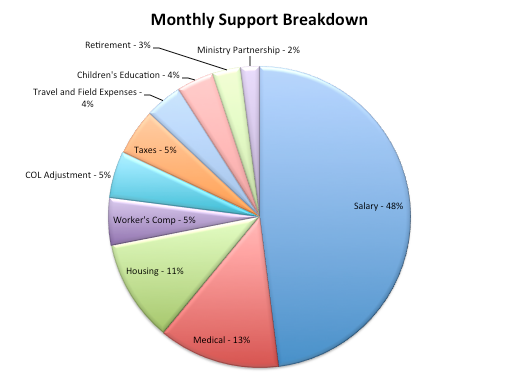
The following explains each of the categories. This was written by MAF, who also provided the pie chart, and it was too good not to copy and paste. I have highlighted a few of my favorite points that are unique to us and our ministry.
Salary:
– MAF compensates our missionary staff at a moderate level based on the “national mean annual income for all occupations” from the US Department of Labor.
– People wonder why a missionary’s salary is “high” even though they live in a country where the cost of living is “low.” Simply stated, an American missionary is still an American who incurs many American costs of living and inevitably pays more than nationals for the same goods and services. (It should be noted that the cost of living here in Kinshasa is actually 92% higher than in the US, and the living standard of the average Congolese person is very different than you or I can imagine.)
– Although nationals survive on very little, this usually does not take into account such things as housing or basic home appliances. The missionary, however, needs these basics as well as computers and communication tools in order to be effective in ministry.
– Although the missionary’s residence is in a foreign country, their citizenship is in America, their children will eventually go to school in America, they will most likely retire in America, etc.
Medical:
– MAF missionaries are covered by a comprehensive and flexible health care plan including medical, dental, and life insurance. Some health benefits are entirely paid by MAF, others are shared by the missionary.
– Sometimes the medical treatment needed may not be available in the ministry location and may require travel to a different location, including returning to North America.
– For life-threatening medical emergencies, overseas MAF missionaries are covered by a third-party international emergency medevac service.
Housing:
– This cost is a worldwide average for MAF missionaries. Housing in most overseas cities today costs as much or more than many places in the US, even if the surrounding areas are impoverished.
Workers Compensation:
– Because MAF is headquartered in America, we are required to carry Workers Compensation insurance on all missionaries.
– Insurance for pilots is one of the highest risk categories. In addition, working in foreign countries is equally considered high risk.
COL Adjustment (cost-of-living):
– MAF’s goal is to achieve equity/parity with our compensation philosophy. This adjustment provides MAF missionaries a subsidy when living in places with very high costs of living.
– The COL is based on an internationally recognized standard used by many mission agencies.
Taxes:
– Because MAF is a US based mission and its missionaries are American citizens, most US payroll taxes apply.
– Some foreign countries levy income taxes on resident missionaries.
Travel and Field Expenses:
– Missionaries have expenses unique to overseas life and work, including passports, visas, licenses, work permits, and immunizations. They also have the expense of travel to and from the field for furloughs, and furlough shipping.
Children’s Education:
– Unlike the USA, free public education does not exist in most overseas ministry locations.
– A missionary child’s education needs to provide a foundation for children to eventually attend school in America. MAF is committed to providing a quality level of education to all missionary children from kindergarten through high school.
– Children’s education costs may include tuition, boarding school fees, homeschool curriculum, travel expense, etc.
Retirement:
– Some missionaries [with other organizations] do not have retirement plans and may still need support once retired. MAF has chosen a different approach and cares for its missionaries in similar ways to that of many businesses in our society.
– Missionaries have the option to contribute to their own 401(k). In addition, MAF has established a matching contribution program.
Ministry Partnership:
– MAF missionaries do not serve alone, but have a team of individuals, churches, and groups that partner with them in ministry through prayer and financial support. “Ministry Partnership” covers the costs of missionary fund-raising and communications with this team.
– To help missionaries connect and communicate regularly and effectively with their ministry teams, MAF provides training, accountability, and resources which include services to print and mail prayer letters, and funding for travel for face-to-face meeting
Who’s On First
Here is your laugh for today…
Macele, my nanny, and I had the following conversation during lunch with the kids one day.
Macele (in very broken English): In English, what is “bon appetit?”
Me (in very broken French): …blank stare… We don’t have anything like that.
Macele, (in French): What do you say when you hand someone their food?
Me (joking, in Lingala): Here! Eat!
Macele (skeptically, in French): You don’t say anything to them before they eat?
Me (in broken French): Well, actually, we say “bon appetit!”
Macele: Uhhhhhh
Me (in French-ish): We say it in French…because there is no English word for it.
Macele: Uhhhhhhh
I think she thinks I’m crazy. Ah well. It was a fun game.
Our First Visitor!
On Saturday, we will be welcoming a visitor! Yes! Someone we know, are not related to, who is a “regular” person, who is coming to visit us and Congo just for fun and adventure! We are so excited. Well, I (Lisa) am probably more excited than Matthew because it is a girlfriend of mine, and she’s not bringing her manly half. (And shout-out special thanks to Sean for letting his wife go and taking on full time care of the boys for two weeks!)
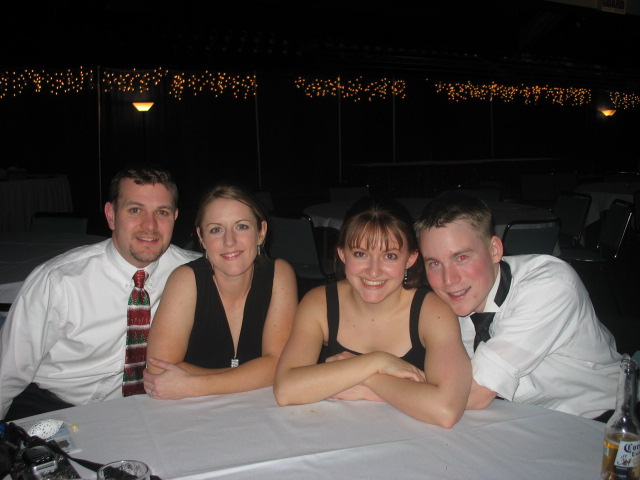
Sean & Sara, with us, at the 2006 clinic Christmas party
Sara and I met in Fairbanks, Alaska when I got a job in the clinic laboratory where she had been working for a few years. She and her husband had lived in Fairbanks for a while and were looking to leave, but she was stuck without someone to take over her job…enter: me. I didn’t mean to take over her job, I merely meant to a be a regular lab technician, testing blood, urine, and all the other specimens we love. But, Sara and I hit it off immediately and she sneakily began training her replacement. After two fantastic years of working together, her husband got a promotion and they left Alaska for his new job in Boise. We kept in touch sporadically over the next two years, but when we went to interview with MAF for becoming missionaries we realized their house was only a short drive from MAF HQ. We stayed in their house and have seen them on and off on each stop in Idaho since. It should be noted that there was a third member of our little lab posse, but she is busy and won’t be able to join us in Africa…we’ll miss you, Tessa.
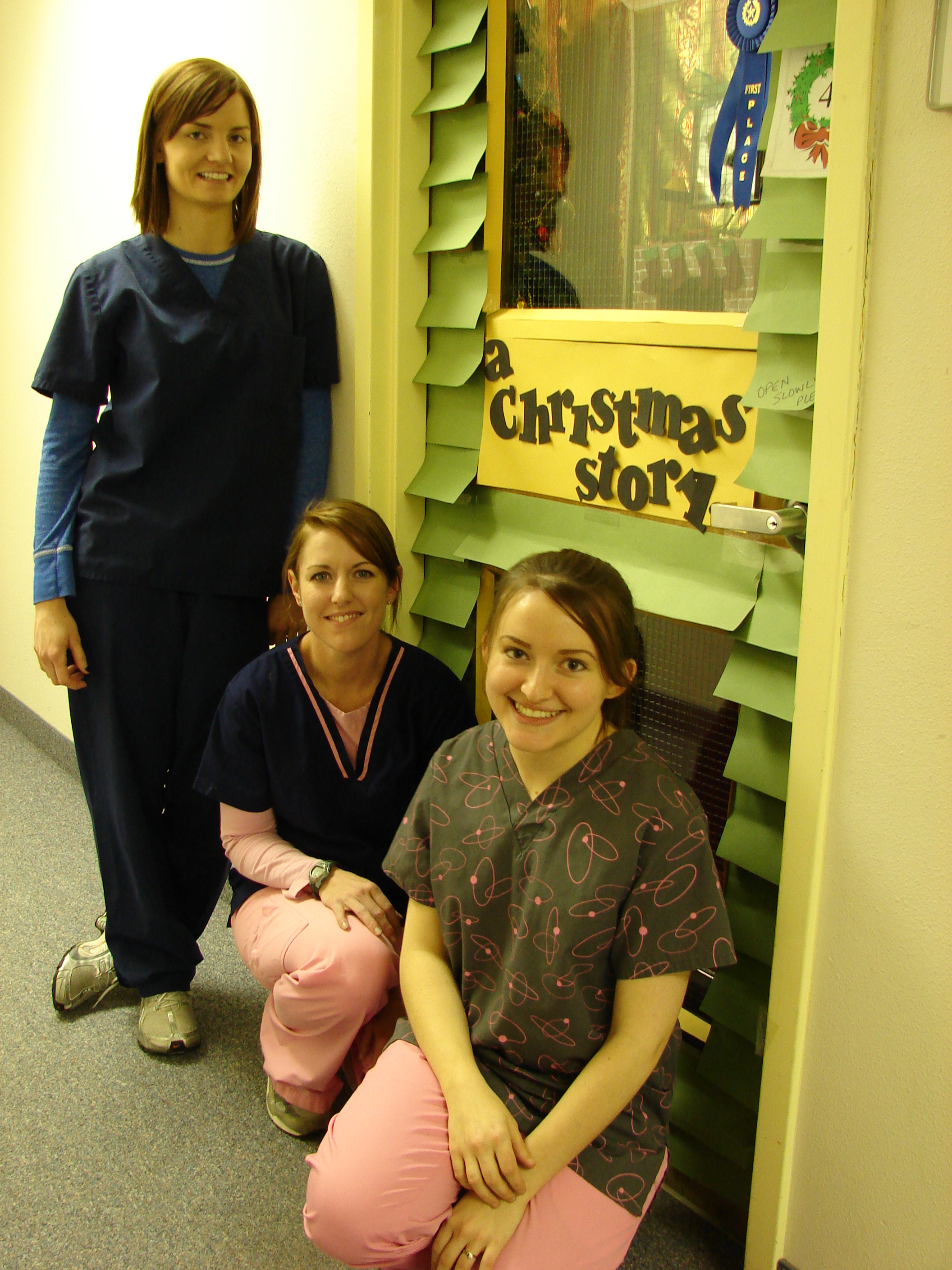
Tessa, Sara and I by our prize-winning Christmas door in front of the lab, 2007
So, in November 2012, we began joking about her coming to visit, but it is REAL and I am excited to share this adventure with a friend. I won’t divulge all that we have planned yet, but I’ll keep you all posted and she is keeping her own blog so you can read all about Congo from a new perspective.
And, let me tell you, if she can make the trip, then some of you should begin making your plans to come visit us when we return in 2014!
It’s just a flesh wound…
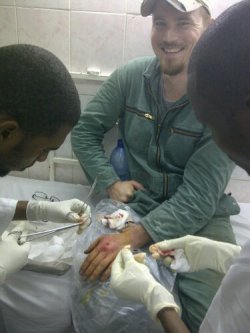
Had an argument with the sheet metal back plate of an air conditioner last night… I lost.
Ron and Fran decided to get a couple split AC units for the office, and said we could use them ’till we depart. Naturally, we were super excited at the prospect of luxurious frozen air (and the kiddo’s heat rash is getting pretty bad), so after an already long day at work I was pushing hard to get one of the units installed in the salon. Everything was going OK, but I should have known when to call it quits. When us Linds used to go skiing, if anyone said “just one more run” that was the red flag… ask Andrew about his trip to the ER that one time. All I really wanted was some air-conditioning!
This is me working on the thing:

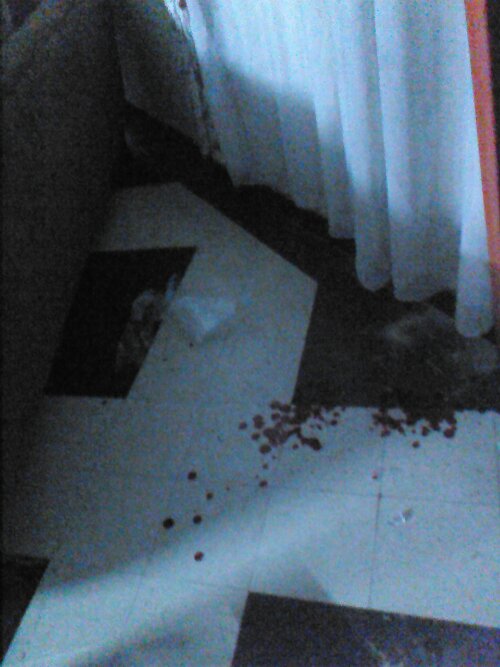
This is my blood on the floor:
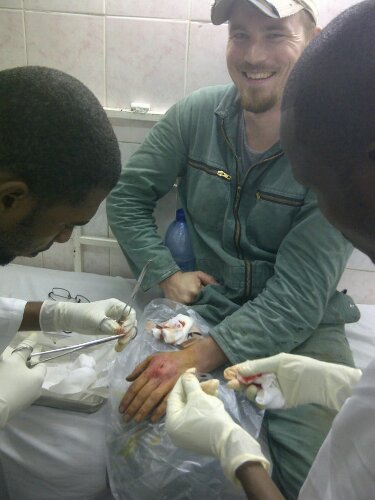
This is me getting stitched:
This is my hand now:
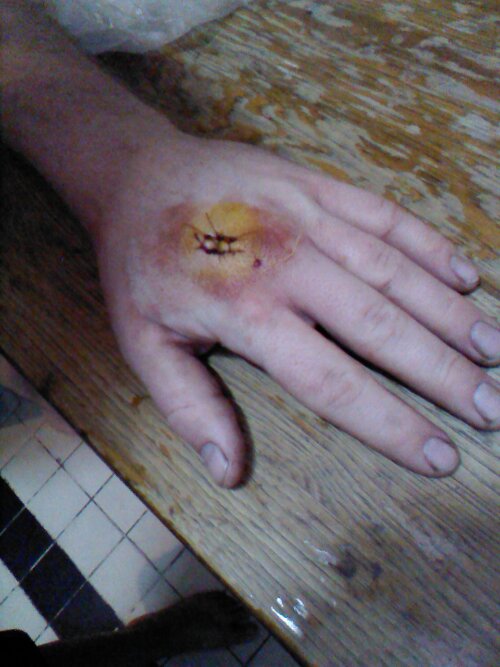
Three stitches, they shot my hand full of Lidocaine, and went through about a gallon of betadine. I was really impressed by the clinic, and glad we had a good first aid kit with plenty of gauze and curlex. Tip of the day: a feminine hygiene pad is great for a compression bandage!
Thanks to Nick and Fran for spending their Friday night sitting in Kinshasa traffic! Oh, and thanks to Mosengo for swabbing the decks free of the blood trail all over the house.
I will be picking up some general antibiotics, and spraying on the veterinary antiseptic (thanks Crissie, vetrycine rocks). So now I just need to get the darn AC in with my left hand at 50%…
A Challenge, Dear Blog Readers
We are constantly blown away by all of our blog stalkers out there. YOU. WordPress provides a lot of statistics for us to gaze upon, but sometimes it doesn’t feel like it matches how many of you slide into a conversation, “oh, yeah, I read your blog.” Oh really? Do you? Oh dear. My writing is not as good as I’d like, despite some amazing teachers in my past (whom read this blog, poor teachers).
Anyway, if you read this blog with any regularity, I am so excited. It means our experience is being shared and that people are thinking of us, hopefully praying for us and loving us in ways we cannot otherwise experience. And thank you for that! Comments are nice, but sometimes just being read and casually mentioning it later, means a lot.
But now we have a new challenge. According to WordPress, if each of you who reads this blog at least twice per month, and isn’t already partnering with us financially, committed to supporting our ministry at just $20 per month, we would be FULLY supported and we could return to Africa as soon as training and language school are finished.
Let me emphasize that we are very much looking forward to seeing many of you in person and traveling around the United States, spreading the word about Congo, the people, and the need to share the gospel – and the need of people to send us to help with that endeavor – but if you, our blog readers, could be the biggest part of those supporters, it would be the most awesome support network we can imagine! First-hand support from you, and first-hand feedback from us – what could be a better partnership?
We know that many of you read because you are already supporting us, and that is fantastic. To the rest of you, I challenge you to look at your resources, at what you see in our previous posts about our work here, and pray for your calling to be part of our ministry in Africa.
Missionary work is not people who go, it is a TEAM of people who support a tiny percentage of people who go. And YOU are reading this blog and I can only presume it is because you CARE about what we are doing here. Now is your chance to really be a PART of it. It matters. You matter. We CANNOT return to Congo until we are fully funded. We want to return as soon as possible – help us accomplish this goal, and know that each time you read this blog, you are reading not just stories of people who went, but reading your own account of helping people in the Congo and doing God’s work here.
So, today marks exactly two months until we leave Congo – and until our 75by3.25 campaign is over. Can you be a part of this ministry with us?
Congolese Food
I know, the Food Post commitment has essentially fizzled, but I think I said the most interesting of things to say. Except for writing about Congolese food.
We love Congolese food, well, most of it. I can’t seem to desire to try the caterpillars, though Matthew has and thought they were quite tasty. And crunchy. And still had eyes staring at you. We had been afraid of the warm, slightly fermented quonga sold on every street corner, but we both really like it, far more than the ultimate staple of Congo: fufu.
The two popular foods, quonga and fufu, have the same staple: cassava flour. The cassava plant’s root is pounded and/or ground into a fine flour. For fufu, it is then mixed with water, and often with cornmeal for flavor, until a thick paste is created. Then, it is formed into large balls and served warm, and is used as the utensil for eating. Fufu is rarely eaten plain. Usually, one picks off a chunk, uses it to scoop, or just dip, into the oils used to cook the other parts of the meal. The Congolese use forks and spoons on occasion, but often don’t bother, since the fufu really takes the place of them. Fufu has a sticky, taffy-like texture, and is a bit chewy. It is fairly bland, but the cassava plant does have a unique flavor.
Quonga is essentially fufu, but without cornmeal, wrapped in banana leaves, warmed until it takes on a fermented smell and served as-is. Quonga is not always high quality, but “good” quonga is actually very good – again, dipped in the oils and mixed with other foods.
The “other foods” I keep mentioning: fish is a common source of protein here in Kinshasa – everything from canned sardines to fresh-caught, since we are on the river. Chicken is saved as a special treat. Papa Willy told us that when your child takes his or her first steps, a chicken meal is expected. Goat is another “fine” meal. Other meats are not very common, though beef, lamb and pork can be found, it is fairly out of reach for the common Congolese person. Eggs are considered special treats and not necessarily found in the everyday diet. The greens here are all cooked and appear similar to spinach. Pondu is the most common, but we prefer biteku or ngai ngai because their flavor is less strong. I make my greens by sautéing onions and garlic in some palm oil (the oil most commonly used here….because they have a lot of palms, of course), then add the greens and a can of whole tomatoes and a bit of salt. The greens cook down and no water is needed. A tasty quick meal is to add cooked rice and some random meat (sausage, chicken, or rabbit) and it’s like the Congolese version of hamburger helper!
Oh, but a meal is not complete unless it contains pili pili. Pili pili is a tiny pepper that is extremely spicy, most often compared to habaneros. It is usually found as a bright red sauce. I add it to the greens or to other sauces for a bit of zest. But you only need a fraction of teaspoon before you’ve created a sense of “whoa.”
Besides the fufu, which is most commonly just served with a tomato/oil sauce with onions and garlic, the Conoglese snack throughout the day. You can buy beans and rice on the street or in many Congolese “restaurants” (stands and a few tables street-side) for just under $2. Bread with either margarine or peanut butter is a common on-the-go fast food, sold by ladies with giant bowls of bread on their heads. Any fruit that is in season, like mangoes, avocados, or other local varieties are cheap and sold by different ladies with large platters on their heads walking up and down the streets. Little packages of sugar biscuits are also a common food, especially for the kids. The Congolese, for the most part, only eat one meal per day and supplement with whatever snacks are handy. Sugary drinks, including Coke, Fanta, and straight grenadine (think, the Shirley Temple drink, without the 7-Up) are more commonly consumed than water. And tea – but with more sugar and [powdered] milk than you would think even possible to dissolve!
You and I might (should) cringe at the thought of a carb-based, sugary diet, especially for children, but it is what it is here. A lot of the Congolese are malnourished, but there is a whole other blog post in itself!
It should be noted that this diet is typical of the Kinois (people of Kinshasa). The diets of people in the villages are quite different, as they have access to more fresh foods, and eat more seasonally, and don’t have pre-packaged foods or beverages as readily available. I’m not saying they’re healthier, but it is a different diet altogether, and varies village to village.
Hopefully that helps digest (ßpun!) the average Congolese diet, but it’s not an exhaustive study of their food. We have had the joy of having Macele cook for us on Wednesdays, making a Congolese dinner for us to eat after she’s gone. It’s cheap and convenient for us, and now that she’s more comfortable, I think she enjoys doing it. We certainly enjoy eating it!
(Note: After this post published, it seems like I did not make it clear that this is about the average Congolese person’s diet, not our personal diet. We have access to many modern stores and nearly any foods you can find in the states. Some are prohibitively expensive, but our diet really hasn’t changed too much, except to incorporate new options.)
Photo 22 Jan

These two get along…mostly.
75by3.25 Campaign Kickoff!
Hey all!
By now everyone should be up to speed on our new plans with MAF. Our current timeline has us returning at the end of March for training and Ministry Partnership – which is where you all come in!
We are launching a campaign to be funded to 75% percent of our new targets by the 25th of March. See the schnazzy logo?
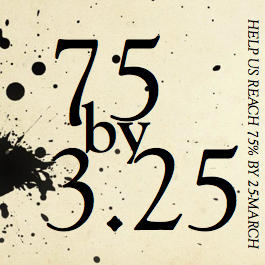
Let’s break it down…
Current Monthly Supporters: Thank you guys big time for keeping the wheels turning thus far. It is encouraging to see your names each month, knowing that you all are stretching the budgets to make it happen, and that those dollars are packaged with love and prayers. We would love for you guys to be able to continue your support in our next term! Is this something you are called to? Might you also consider increasing your support amount by $5-$10 dollars each month? For the cost of a burger-run we can make a bigger impact than McDonalds (although, we are not as tasty).
Single-Gift Supporters: You helped us make it out here – from the vaccines, to the plane tickets, to underwriting the cost of several months of our total project. Y’all’s generosity and outpouring of love for God’s people in Africa has us constantly blown-away. Please pray and consider if you could once more bless our ministry with financial support. Maybe you would like to become a monthly supporter?
Fan Club: Major thanks for all the prayers, encouragement, advice, and myriad of ways in which you have helped. Please pray about what ways you may be called to join in our ministry… Have you thought about becoming a financial partner? A gift of just $20 a month is a big deal for us!
Prayer Warriors: Keep up the good fight! There is so much needing done here in Congo! The country is in the midst of a desperate spiritual battle and people here are hurting in every way. Please add to your prayers that God would put a call on the hearts of those he wants to do his work here – whether it is packing their bags and jumping on an airplane, or working a steady job stateside and helping the harvesters pay the bills.
Everyone: I would like to challenge you all to share about our ministry with one other person this month. Think about who might be interested in what God is doing out here – send them an email with a link to our web page, chat with them over coffee and show them one of our photo posts, message them on Facebook and link to our blog, or catch them at work and ask them to join you in praying for us once a month. Our prayer card has a great QR code, so if you tote one of those in your Bible your tech-savvy friends are a scan away from getting plugged in!
The real numbers? Our monthly support target is $7,200 and our outgoing costs are approximately $15,000. Our 75% goal would mean $5,400 and $11,250 respectively. We are crunching the numbers to see exactly where we are now… but somewhere near 50% is what we are thinking.
Oh, and with all the new changes in the tax code this year, the right size donation might just put you in a more favorable bracket…
Expect to see a lot of that new graphic floating around our side of the cybersphere for the next couple of months! Hit us up with feedback or questions at any time – you can drop a comment here or email us at mlind@maf.org. Let’s make this happen!
Picture Post: Christmas and Beyond
Here are all of the best pictures from our Christmas time and a few since we’ve been back. I spent time arranging them all in the perfect order, which took a while with African internet, and then it didn’t save it. So, here they are, in a more eclectic order. See below for an explanation of the last photo.
-
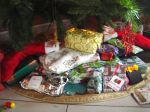
- The bounty from grandmas and grandpas (and one auntie)…and a few from and for Mom and Dad
-
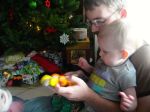
- Opening her first gift on Christmas Even morning…
-
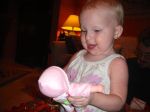
- “BABY!”
-
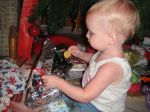
- Amelia thought this wrapping paper indicated crackers…to the point where she was not coping well with the disappointment that it was NOT crackers, hence the cracker
-
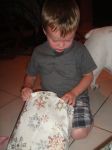
- Opening a gift from Grandmama Lind
-
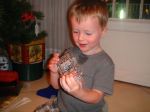
- Levi LOVES his Tintin car, from Jocelyn
-

- Ummm, ShUGA…
-

- My only Christmas picture…and boy do I look tired! Ah well…
-
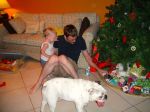
- Starting to open presents…
-

- ShUGA and Amelia were best buds
-

- Levi’s new tool belt
-
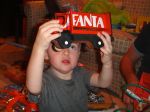
- Loving his new Congolese trucks
-

- Funny snakes from FarFar (Father’s Father in Swedish)
-
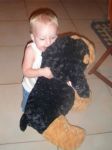
- Matthew’s gift to Amelia – a large, yet-unnamed puppy
-
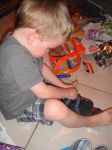
- Levi, trying on his new shoes
-
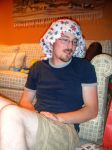
- Matthew’s only Christmas picture…hmmm.
-
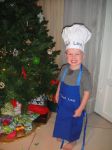
- Chef Levi!
-

- ShUGA – the best part of the Christmas house
-
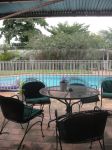
- The other best part about the Christmas House
-
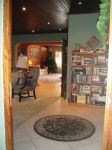
- From the entry way of the Christmas House
-
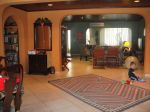
- The arch on the left goes into the kitchen…
-
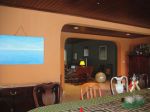
- From the dining area into the living room
-
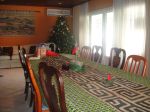
- The large dining table, which saw plenty of use during our stay
-
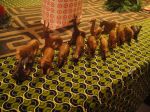
- Sherry, of the Christmas House, has the best collection of napkin rings, collected from all over Africa. And stored in a Target bag!
-
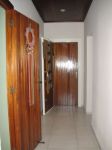
- The hall – the door at the end is to Levi and Amelia’s room
-
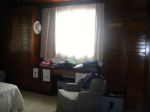
- In the master suite, the built in cabinets were gorgeous
-
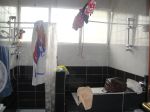
- The bathroom of the master suite – untidied.
-
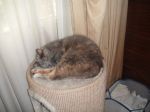
- Lillie, the elusive cat
-

- Making 7 quarts of spaghetti sauce…out of the tiniest, Congolese-style tomato paste cans…because it’s what I already had.
-
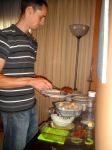
- Nick beginning the feast on Christmas Day
-
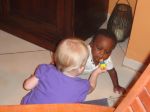
- Amelia feeding the other Levi Alan (her brother’s name is Levi Allen)…feeding him a duplo person
-
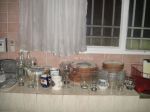
- Christmas Day dishes…which didn’t phase Taty, the Chef/house worker, one bit!
-
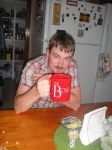
- Matthew found a mug that he really likes in the Christmas House collection
-

- The Christmas House was well loved and well used!
-
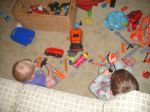
- The kids on Christmas morning
-
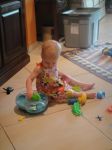
- Amelia loves the gift from her Auntie Jenny!
-

- Levi having fun with Christmas House duplos
-
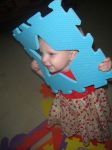
- Amelia…a shining star
-

- Ruth – adorable as always!
-

- Girl talk
-
- Bonne Fette, Amelia!
-
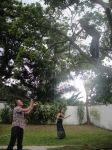
- Picking avocados for our Congolese workers and their families before the big Christmas party for them. Don’t miss Nick IN the tree!
-
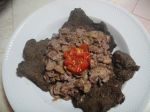
- Another one of Chef Taty’s feasts at the Christmas House
-

- Nick was very good at drawing trees.
-
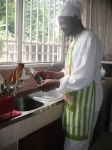
- Chef Taty preparing our Congolese feast
-

- Poisson (French for fish)…it was soooo tasty!
-
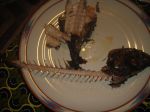
- Sorry the lighting is terrible, but we all agreed this reminded us of cartoons from our childhood.
-
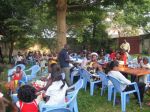
- Our pastor had a church-wide meal for New Years and celebrated with 100 friends!
-

- Levi taking on the Congo River on New Years Day
-
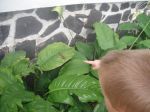
- Found at our house once we returned: Biblical style locust!
-
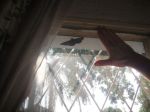
- Another creature found at our house upon return…the biggest moth ever!
-
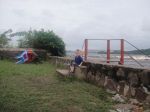
- Remembering their younger sibling at Chez Tintin, Sunday, January 13.
On Sunday, in lieu of church, we went out to a little park-like area on the Congo River to reflect and remember our lost little one. We admired the river, talked to the kids, and sang a hymn, Abide with Me, my personal favorite. It was a wonderful family time, and nice to be out to this place before we leave, since we hadn’t yet visited. The river was extremely high, and it moves quickly, but the kids enjoyed it and it was nice to have a time to really say goodbye. Thank YOU for all of your prayers and notes of encouragement. They have meant a lot to us this past week.

 The Lind Family